
Draft West Surrey scheme caps support at 85% from April 2027. In Spelthorne 1,919 households would get less, 591 more. Say what you think by 3 December.
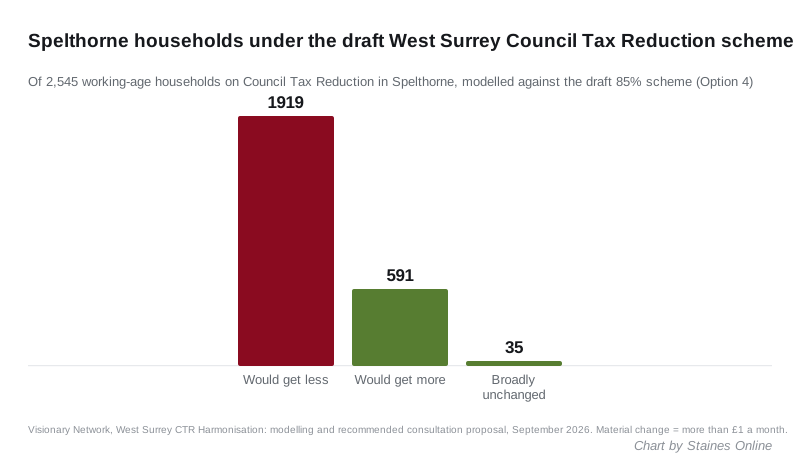
Three in four Spelthorne households on Council Tax Reduction would get less help under the draft scheme for the new West Surrey Council. The council’s own modelling puts it at 1,919 of 2,545 working-age households receiving less from April 2027, with 591 receiving more and 35 broadly unchanged.
The consultation opened on 7 October and closes on 3 December 2026. Spelthorne Borough Council asked residents for their views on 7 October, and the full proposals sit on the Surrey LGR Hub. Nothing has been decided. The final decision is expected in January 2027.
What is being proposed
Council Tax Reduction, which Spelthorne calls Council Tax Support, cuts the bill for people on low incomes. Six different schemes run across the six councils that become West Surrey next April, so one has to replace them. The draft, called Option 4 in the modelling, has five main rules, set out in the consultation FAQs:
- a maximum award of 85% of the bill, so every working-age household pays at least 15%
- support capped at Band D, so households in Bands E to H get help only up to the Band D amount
- a £6,000 capital limit: anyone with savings above that gets nothing
- a 20% taper, so help falls by 20p for every £1 of income above the allowance
- a flat £10 a week deduction for each other adult in the home
The draft also drops any minimum award, drops Second Adult Rebate for working-age claimants, allows backdating of up to three months, and assumes a self-employed claimant earns at least 35 hours at the minimum wage after a 12-month start-up period. Pensioners are not affected: they stay on the national scheme.
How that compares with Spelthorne today
Spelthorne’s current scheme is one of the least generous of the six, which is why it has more gainers than most. The council’s Council Tax Support page says working-age claimants pay at least 25% of their bill, and people with disabilities pay at least 10%. The comparative analysis prepared for the consultation records the rest:
| Rule | Spelthorne now | Draft West Surrey |
|---|---|---|
| Maximum support | 75%; 90% for the Class G protected group | 85% for everyone |
| Band cap | None | Band D |
| Savings limit | £16,000, with £1 a week counted per £250 over £6,000 | £6,000, nothing above it |
| Other adults in the home | £5.20, £10.60, £13.30 or £15.95 a week by income | £10 a week flat |
| Second Adult Rebate | Kept for working-age claimants | Not offered |
| Taper | 20% | 20% |
Class G is Spelthorne’s local protected category. It raises the maximum from 75% to 90% for households meeting specified disability, capability, disabled-child or permitted-work criteria. The draft has no equivalent, which is why the equality impact assessment lists Spelthorne’s “disability/capability groups” as able to lose existing protection, and names the Band D cap and the £6,000 savings cliff as “additional risks” here.
Who gains and who loses in Spelthorne
The modelling was done by consultants Visionary Network on a caseload extract of 19 August 2026. Its modelling report gives the Spelthorne line:
- 591 households (23.2%) would get more than £1 a month more
- 1,919 households (75.4%) would get more than £1 a month less
- 35 households (1.4%) would be within £1 a month of today
- the borough’s total award would fall by about £386,000 a year
Spelthorne and Runnymede are the two areas with substantial groups of gainers, the report says, “because the common means test changes assessment as well as the headline maximum”. In Guildford, Waverley and Woking, which give 100% support today, almost every claimant would lose. Across all six areas, 10,683 of 12,174 households (87.8%) would get less and the total bill for the scheme would fall from £19.4 million to £16.3 million, a cut of £3.1 million a year.
The typical loser across West Surrey loses about £24 a month, or £258 a year. The spread is wide: 7,804 households lose £1 to £25 a month, 1,676 lose £25 to £50, and 327 lose more than £100 a month.
What the 85% rule means on a Staines bill
Band D in Spelthorne is £2,526.49 this year, from our council tax bands page. Our own arithmetic on that figure, which the consultation papers do not do for Spelthorne specifically:
- a Band D household getting maximum help pays at least £631.62 a year now (25%), and would pay at least £378.97 under the draft (15%)
- a Band D household in the Class G protected group pays at least £252.65 now (10%), and would pay £378.97, so the people the current scheme protects most are the ones who go backwards
- a Band E household, bill £3,087.93, would have its help capped at the Band D level of £2,147.52, leaving at least £940.41 to pay, 30.5% of the bill, against £771.98 now
The band cap is new to Spelthorne. The comparative analysis counts 197 Spelthorne claimants in Bands E to H, 7.7% of the caseload: 168 in Band E, 24 in F, 4 in G and one in H.
The savings rule is the sharpest edge. Today a claimant can hold up to £16,000. The draft removes all help above £6,000. Across West Surrey, 149 current recipients have recorded savings above £6,000 and would lose their whole award.
Who claims in Spelthorne
The papers also describe the caseload the change lands on:
- Spelthorne has 5.7 claimant households per 100 properties, the highest of the six areas (Runnymede 5.1, Woking 5.0, Waverley 3.9, Surrey Heath 3.6, Guildford 2.8)
- 1,247 are single adults, 885 are lone parents, 187 are couples and 226 are couples with children
- 559 households (22%) have another adult living with them, the highest share in West Surrey, so the flat £10 deduction falls hardest here
- the deprivation screen names three Spelthorne wards among its ten priority wards: Stanwell North, Sunbury Common and Ashford North and Stanwell South
Transitional protection is proposed only for claimants moving off a banded or non-taper assessment, which means Runnymede and Surrey Heath. Spelthorne’s scheme is already taper based, so no protection class is proposed for anyone here.
What it means for you
If you get Council Tax Support now, nothing changes before 1 April 2027. Your current award continues to 31 March. After that the new rules apply, whatever they end up being.
If you pay the 25% minimum today, the draft is likely to cut your bill. If you are in the Class G group, have savings between £6,000 and £16,000, live in Band E or above, or have a working adult child at home, it is likely to raise it. The report’s own numbers say more Spelthorne claimants lose than gain by about three to one.
To respond before 3 December:
- read the proposals and fill in the questionnaire on the West Surrey consultation page
- or email Ctrswestsurrey@surreylgrhub.gov.uk, or phone 01276 707100 (Surrey Heath’s contact centre is handling calls for West Surrey)
- paper copies and accessible versions are available from the council offices at Knowle Green
Residents across Surrey will get a text or email about the consultation through GOV.UK Notify. The hub says those messages are genuine. A summary of responses and the outcome will be published after the decision, and the new council is expected to take it in January 2027.
Have your say